
Introduction to Speaking Under Pressure [00:00:02]

Have you ever wondered how some people are so good at speaking under pressure at work? Maybe it's your manager or a coworker who always knows exactly the right thing to say at the right moment to achieve a certain outcome. Today, I'm sharing in a video that's less than 20 minutes something that took me over four years of messing up at work to realize: how to articulate your ideas effectively in high-pressure meetings. If you're new to the channel, welcome. My name is Matt. I've spent the last four years working in roles across big tech, management consulting, and banking. On this channel, I share everything I've learned in my professional career. So if you're here today, thank you. But if you're still with me, lock in, full screen the video, and follow along. Let's get into it. I want to start by defining what a high-pressure situation even is. I know many of you are probably thinking, of course I know what that is. But a high-pressure situation, specifically a high-pressure meeting, is typically one where you're not indifferent to the outcome. This means you care a lot about achieving a certain outcome or convincing the audience in the meeting to take a certain action. A common example at work is if you want to get promoted this cycle, so you're about to go into a meeting with your manager where you're going to ask, "Hey, can you put me up for promotion this cycle? I've been working so hard over the last six to 12 months, putting in all the hours, arriving at the office before everyone else, leaving later than everyone else, and being a big team player." And you really want your manager to put you up for promotion.
The Three-Step Process for High-Pressure Meetings [00:01:54]
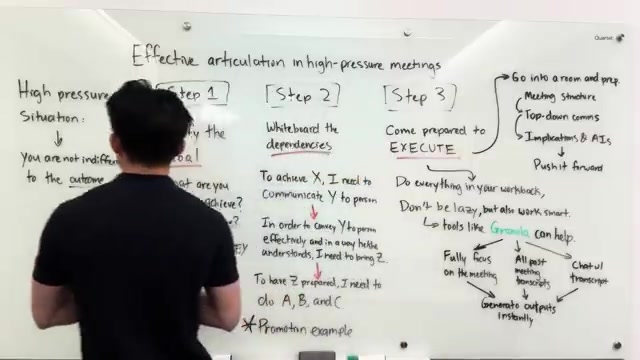
You're not indifferent to that outcome; it has a lot of meaning to you. I'm going to walk you through the three-step process that I still use today in every meeting at Google where I need a certain outcome or to convince the audience of an action they should take. Step one: clarify the objective. You need to clarify the goal. What do I mean by this? Often, you have a general idea, like "I want to get promoted" or "I want to convince them to take this action." But what are you actually trying to achieve in that specific meeting? For example, if you're trying to get promoted, you're not actually getting promoted in that meeting. You're trying to convince your manager to put their neck out for you by nominating you for promotion. For those unfamiliar with how tech promotions work, typically your manager has to nominate you, and then a higher-level committee decides. But your manager won't nominate you if they don't believe you'll reflect positively on them. So you're essentially asking them to take a risk for you. The second question you should ask is: why do you care? In the promotion example, it's pretty clear—I want to make more money, have a cooler title, more responsibility, and so on. But it's never a bad idea to reflect on why you care about the outcome you're driving. Finally, this is the step most people miss: why should they care? Think hard here. Why should your manager care about putting you up for promotion? It's clear to you, but what's in it for them?